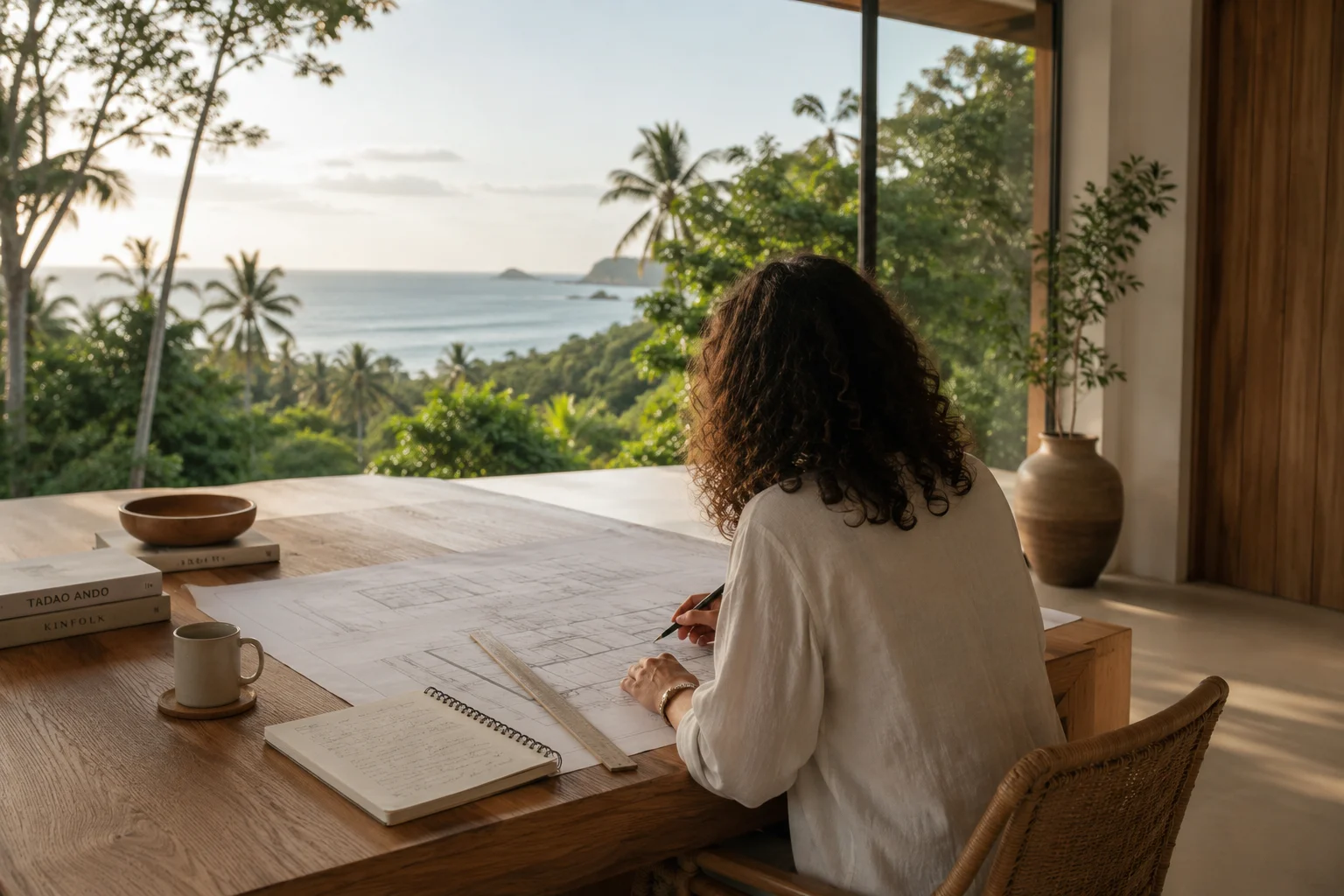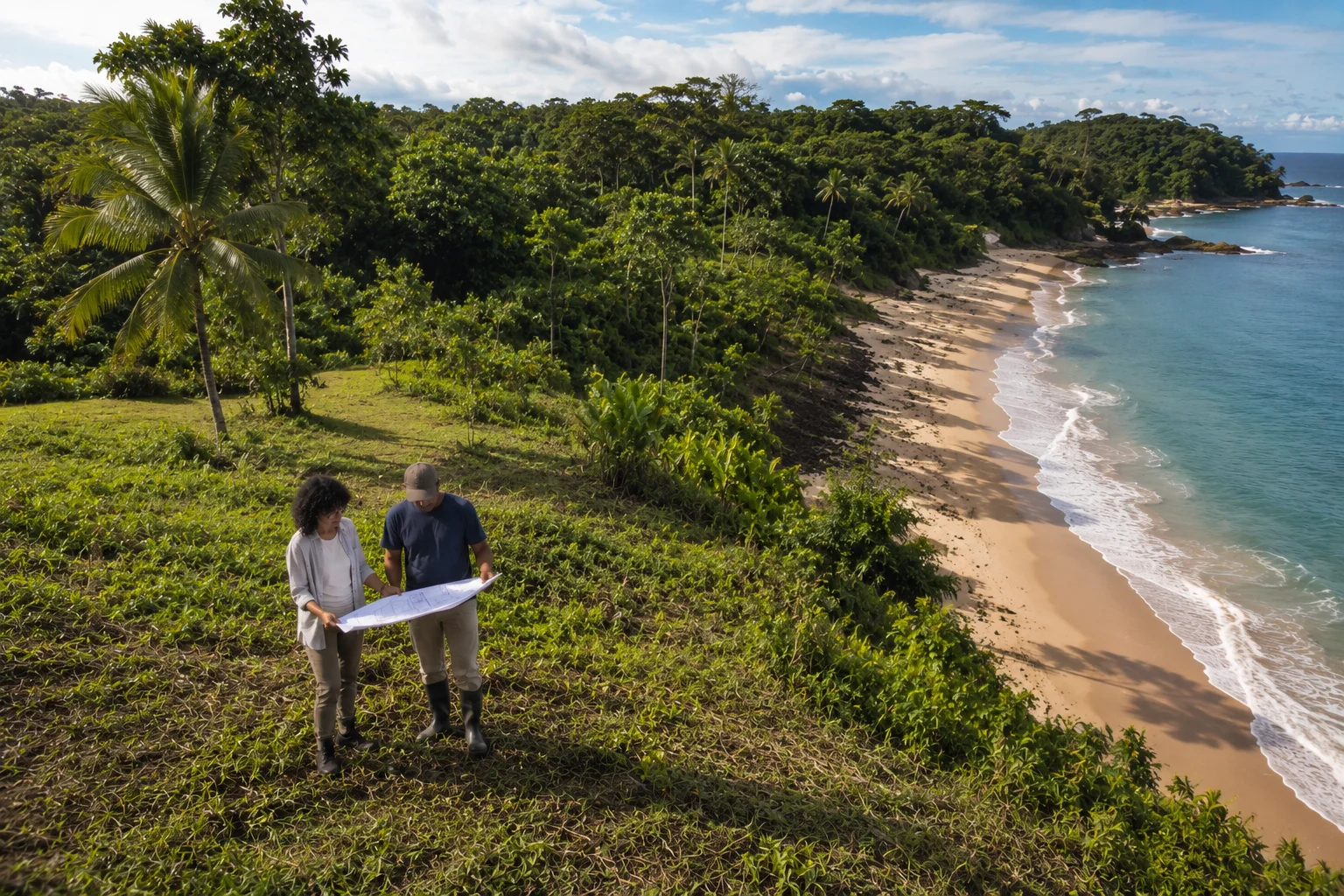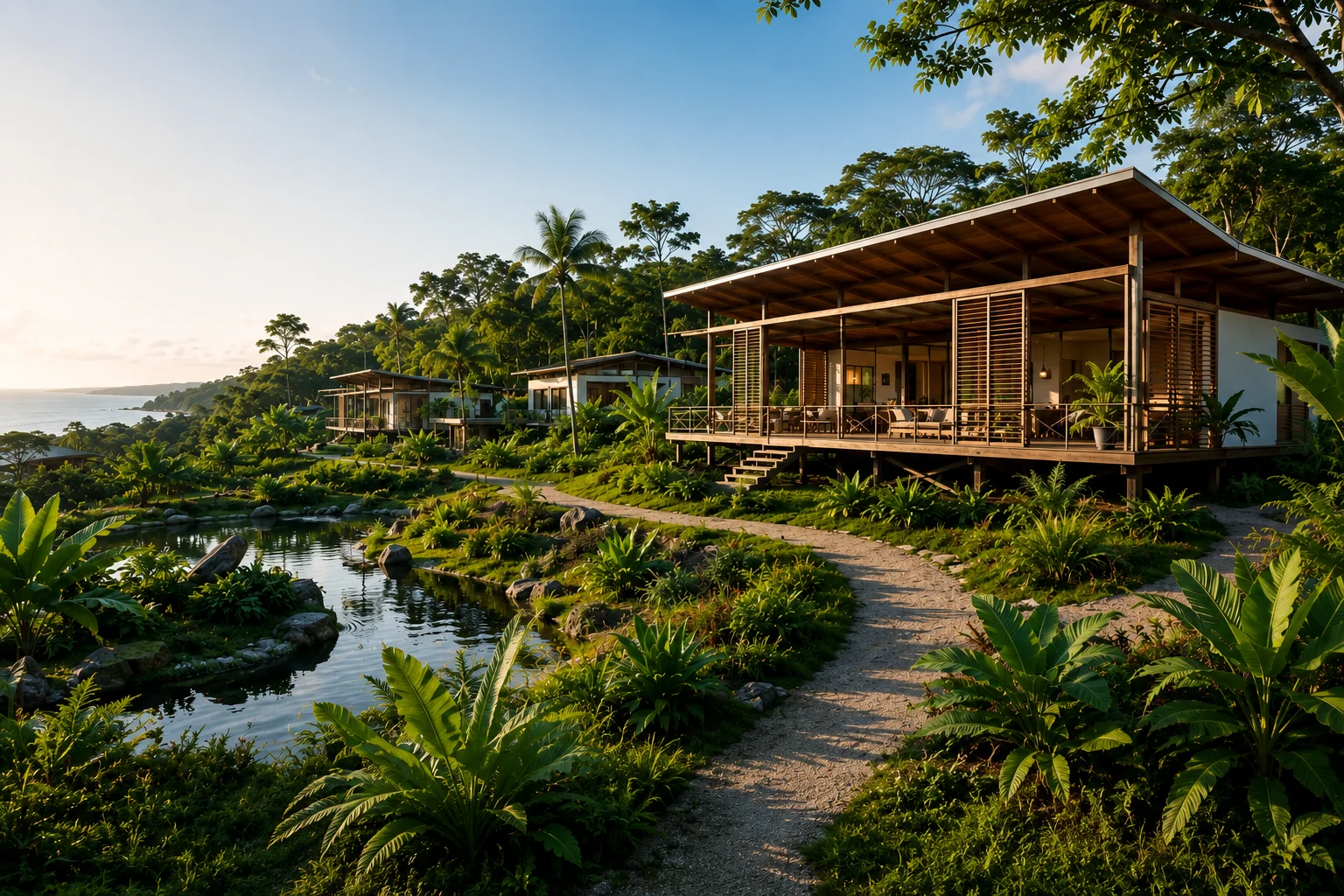
In recent months, a search phrase has been appearing with growing frequency in Google from Panama and abroad: mixed bioclimatic real estate projects. The question behind it is not purely technical. It is a signal that something is shifting in the way people want to live — and in what they look for when investing in tropical real estate.
This article explains precisely what a bioclimatic real estate project is, how it differs from conventional construction, what makes it viable in Panama, and why Costa Arriba de Colón is becoming one of the most relevant territories for this development model.
01 What "bioclimatic" means — and what it does not
The term bioclimatic is used — and overused — in the real estate market. Precision matters here.
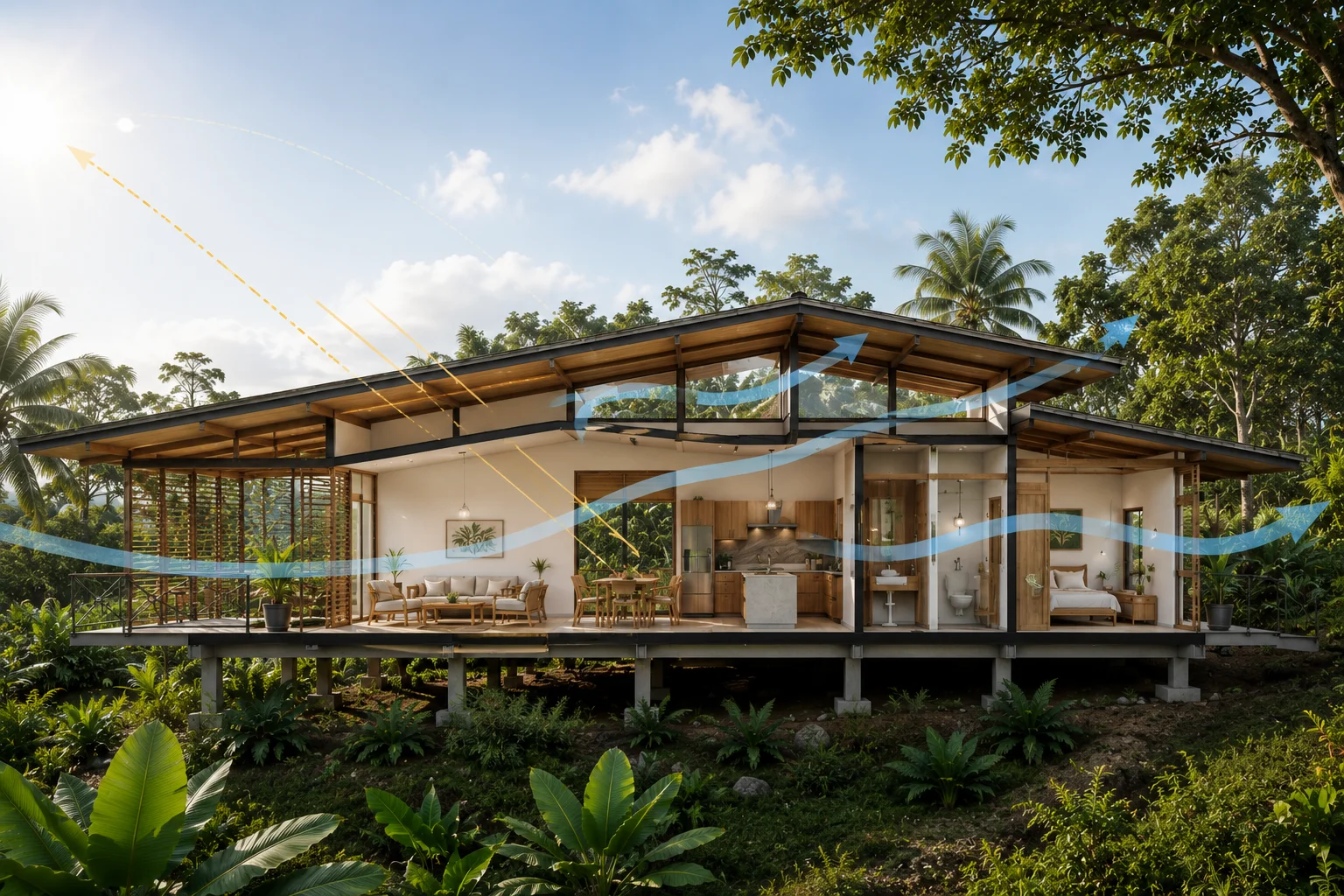
A bioclimatic architecture project is one that designs the building in response to the local climate: solar orientation, prevailing winds, temperature, humidity and existing vegetation. The goal is to achieve thermal comfort, natural ventilation and daylighting without depending — or depending minimally — on mechanical systems like air conditioning.
In the Panamanian tropics, that means designing with the rain, not against it. With the heat, not ignoring it. With the Caribbean or Pacific breeze, not sealing the house so that a refrigeration unit does what the design should have resolved from the drawing board.
What it does not mean: imported European materials, costly certifications that inflate the budget without improving real performance, or any specific aesthetic. A bioclimatic house can be block, timber, bamboo or concrete. What defines it is how it responds to its environment — not what it is made of.
"Air conditioning is the most expensive solution to a problem that good design should have resolved from the start."
02 What is a mixed bioclimatic real estate project
A mixed real estate project combines different types of use or unit within a single masterplan: residential homes, short-term rental units, shared amenities, productive areas or conservation land. "Mixed" refers not only to uses — it can also mean a mix of user profiles: resident families, owners who rent their unit, long-term digital nomads.
When that model is combined with bioclimatic design, the result is a type of development that is still rare in Panama but has a clearly identifiable demand: people who want to live well in the tropics, with low operating costs and high environmental quality, without giving up connectivity or comfort.
| Feature | Conventional project | Bioclimatic mixed project |
|---|---|---|
| Orientation and ventilation | Secondary to design | Determines the design |
| Monthly energy cost | High — 24/7 air conditioning | Low or zero |
| Conservation area | Legal minimum (5–10%) | 60% or more of the site |
| Buyer profile | Mass market / speculative | Own use / long term |
| Value in 10 years | Depends on general market | Scarcity + differentiation |
| Maintenance | Intensive in mechanical systems | Low if design is correct |
03 Why Panama — and especially Costa Arriba — is natural territory for this model
Panama has exceptional conditions for bioclimatic development. A tropical climate with predictable variations, extraordinary biodiversity, coastlines on two oceans, and a geographic position that attracts both Panamanians looking for a second home and foreigners who want to live in Latin America without sacrificing international connectivity.
Costa Arriba de Colón — the coastal corridor running from Portobelo to Santa Isabel, through María Chiquita — concentrates several of those conditions in a territory that is still largely undeveloped: Caribbean sea, tropical rainforest, access to Panama City in under 90 minutes, and a human scale that the large Pacific developments lost years ago.
It is also a territory where good design is not a luxury — it is a necessity. Salinity, constant humidity and logistical distance from major supply centres force design decisions that can be ignored elsewhere in the country. That difficulty, paradoxically, produces more honest and more durable architecture.

04 The five principles that define a genuinely bioclimatic project
Not every project that uses this term is one. These are the principles that distinguish a genuinely well-conceived development from one that uses "bioclimatic" as marketing.
-
01
Orientation and cross ventilation as the starting point. The masterplan is designed around prevailing winds and solar trajectory before anything else is defined. In Costa Arriba, that means opening buildings towards the northeast breeze and shielding them from the western sun. A project that begins by drawing plots without analysing wind patterns is not bioclimatic.
-
02
Low density with high conservation area. A 15-hectare project should have no more than 20 units if it wants to preserve the environmental quality that justifies it. 60% of the land in conservation is not an aesthetic gesture — it is what guarantees that the site's microclimate does not change once the project is built and occupied.
-
03
Materials suited to the environment, not imported for fashion. Locally treated timber, concrete with marine protection additives, roof pitches designed for tropical rainfall — these are the right materials for the Panamanian Caribbean. Aesthetics come after durability. A beautiful material that fails in five years is the most expensive mistake a project can make.
-
04
Infrastructure that reduces dependence on external systems. Rainwater harvesting, greywater treatment, solar generation for shared areas — not as a certification, but as a real reduction in the monthly operating cost of each unit. The goal is for living there to cost less every month, not just once at purchase.
-
05
Integration with the existing community. A project that ignores the social and economic fabric of the territory it occupies is not sustainable. The best bioclimatic developments create local employment, source materials from nearby suppliers, and do not close off access to the sea or forest that existed before they arrived. In Costa Arriba, this is not rhetoric — it is part of the social contract with the territory.
05 The profile of who looks for this type of project
In 17 years working in Costa Arriba, the buyer or investor interested in bioclimatic projects has a fairly consistent profile. They are not necessarily someone with an explicit environmental agenda — often they are simply someone who has done the maths.
-
The upper-middle-class Panamanian family looking for a second home
They want somewhere to spend weekends and school holidays that is not a gated community without identity. They want real nature, not decorative landscaping. And they have calculated that a house without air conditioning saves between $300 and $600 a month on electricity — an economic argument that outweighs any environmental one in the family conversation.
-
The digital nomad or long-term foreign professional
Works remotely, seeks quality of life without the cost of Miami or Lisbon. Panama offers dollarisation, good international connectivity and a digital nomad visa. Costa Arriba offers what Panama City cannot: space, nature, quiet and access to the sea. This profile particularly values a community of people with similar interests.
-
The investor seeking differentiated tourism rental income
The boutique sustainable accommodation market in Panama has growing demand and little quality supply. A well-designed unit in a natural setting with Caribbean access can generate occupancy rates far above a conventional apartment, especially in the nature and wellness tourism segment that grows year after year in the Latin American market.
06 Comunidades Biotopos: the model we are developing in Costa Arriba
Biotopos has been building in Costa Arriba de Colón for 17 years. We know the territory, its technical conditions, its regulations and its community. From that knowledge we have developed the concept Comunidades Biotopos: a low-density bioclimatic real estate development model aimed at the upper-middle Panamanian segment and the digital nomad and foreign resident market.
The typical masterplan comprises 15 hectares, 20 residential units of between 120 and 180 m² each, 60% of the land in conservation, and shared infrastructure — rainwater harvesting, water treatment, community area. Each unit is designed to function without air conditioning under normal occupancy conditions.
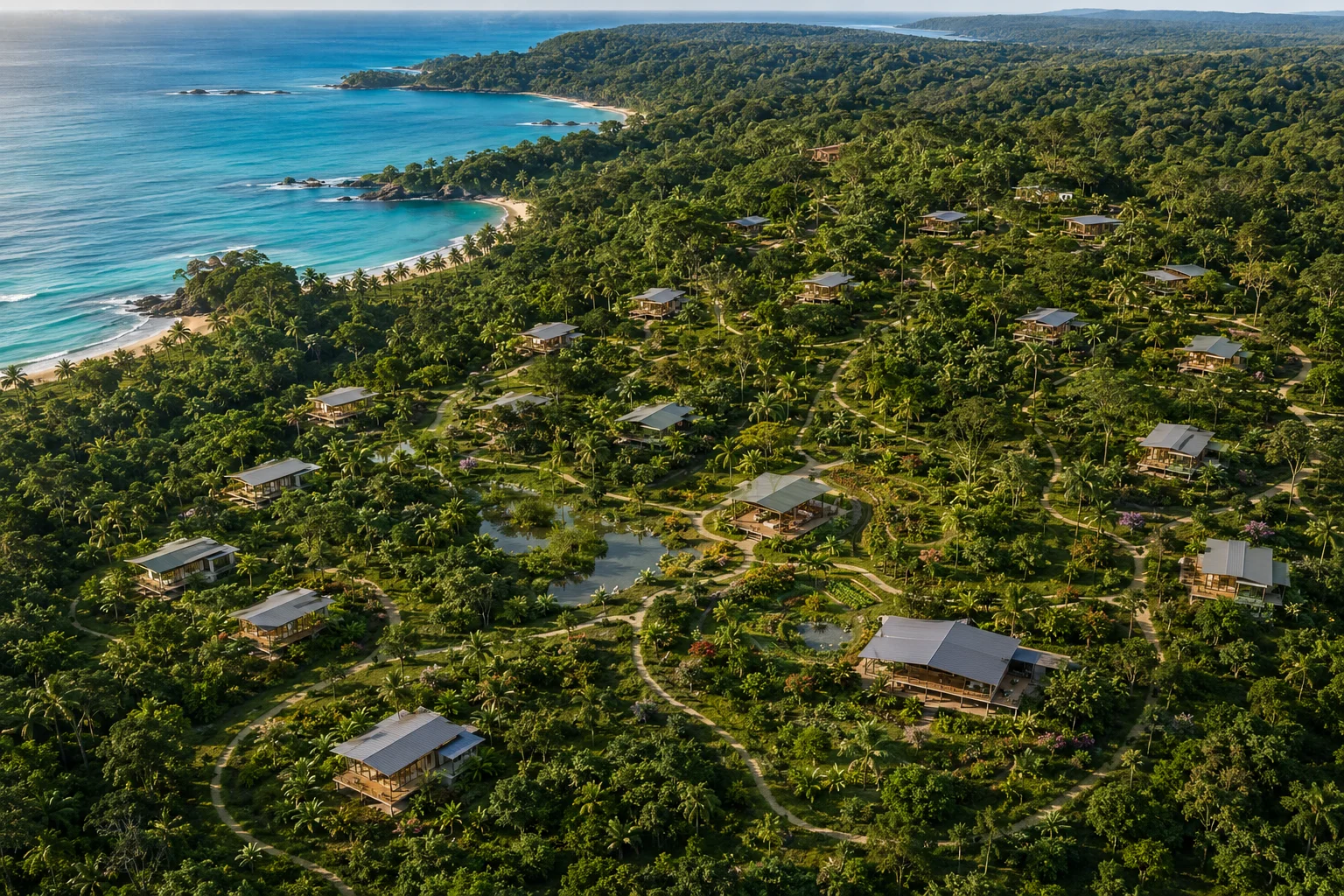
The investment range per unit is between $80,000 and $120,000 USD depending on size and location within the masterplan. It is not the cheapest product on the market — nor does it aim to be. It is the right product for anyone who understands that the real cost of a house includes what it will cost to live in it for the next twenty years.
"We don't sell square metres. We sell the possibility of living well in the tropics without the tropics costing a fortune every month."
07 Four questions to assess whether a bioclimatic project is genuine
Before investing in any project that uses this term, there are four questions worth asking the developer or responsible architect directly. The answers must be concrete — backed by completed projects, not concepts.
-
01
What is the orientation of the units and how is it justified? If the answer is vague or does not mention prevailing winds and solar trajectory, the project is probably not bioclimatic — it just uses the name. Orientation must be justified with local climate data, not intuition.
-
02
What percentage of the land is in conservation? Less than 40% in a tropical zone is a red flag. 60% is the minimum standard for the project's microclimate to hold over time. A project that maximises land coverage cannot seriously call itself bioclimatic.
-
03
What is the estimated monthly electricity cost per unit? A well-designed project should be able to answer with a real range based on comparable completed projects. If the answer is "very low" without reference data, it is rhetoric — not architecture.
-
04
Who is the architect and what have they built in similar climatic conditions? Bioclimatic design in the Panamanian Caribbean is not learned from books — it is learned by building in the Panamanian Caribbean. Ask to see completed work, not renders. If there is no finished construction to reference, there is no real basis for comparison.
At Biotopos, every one of those questions has a concrete answer. Because we have spent 17 years building in exactly that territory, under those conditions, for that type of project. If you are interested in learning more about Comunidades Biotopos, or if you have land in Costa Arriba you want to evaluate, the first conversation costs nothing.
Before moving forward on any coastal project, it is also worth understanding the regulatory framework that applies. The article Can I build on my beachfront land in Panama? explains the four variables — MiAMBIENTE, ANATI, title type and coastal sub-zone — that determine what is possible before a single line is drawn.