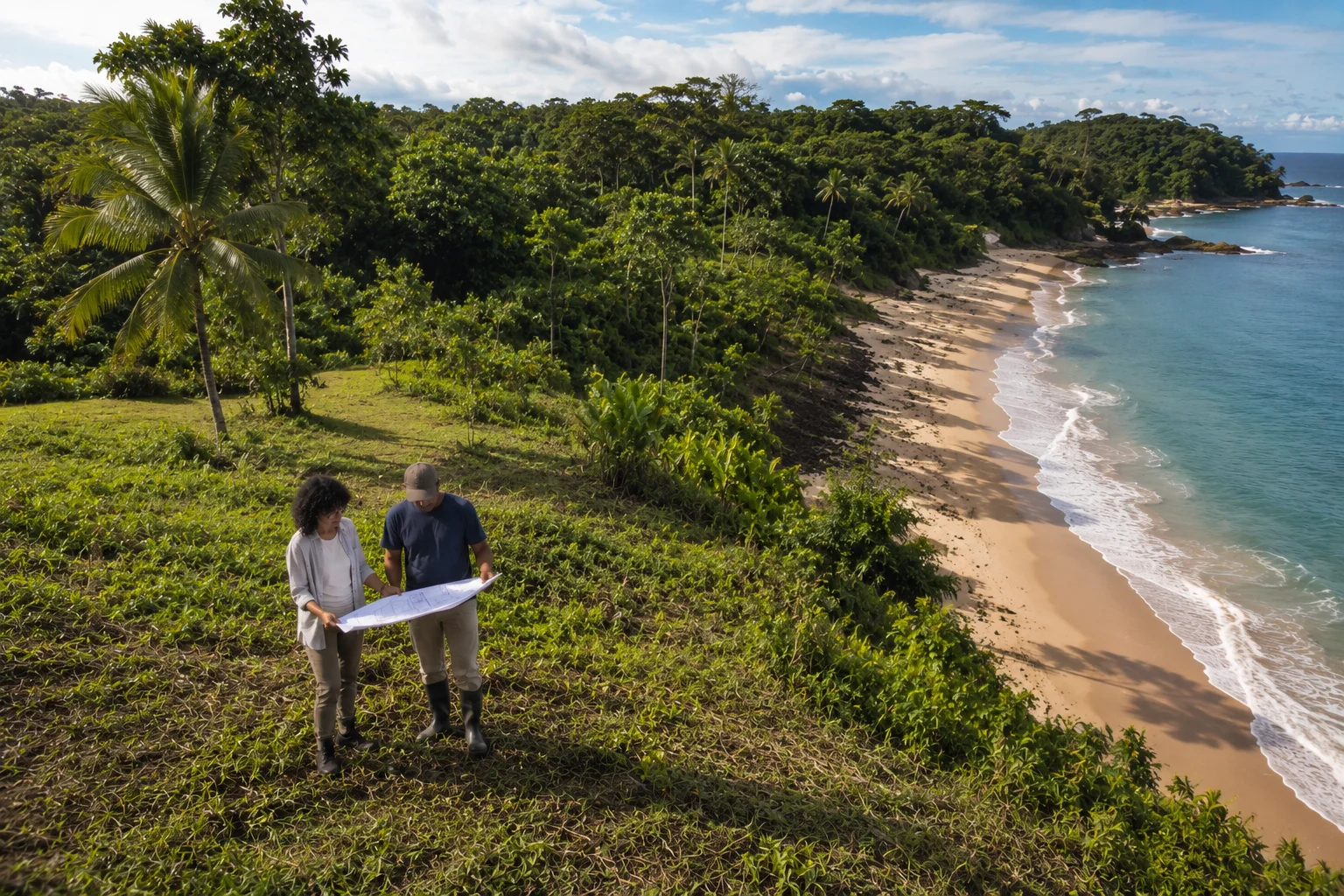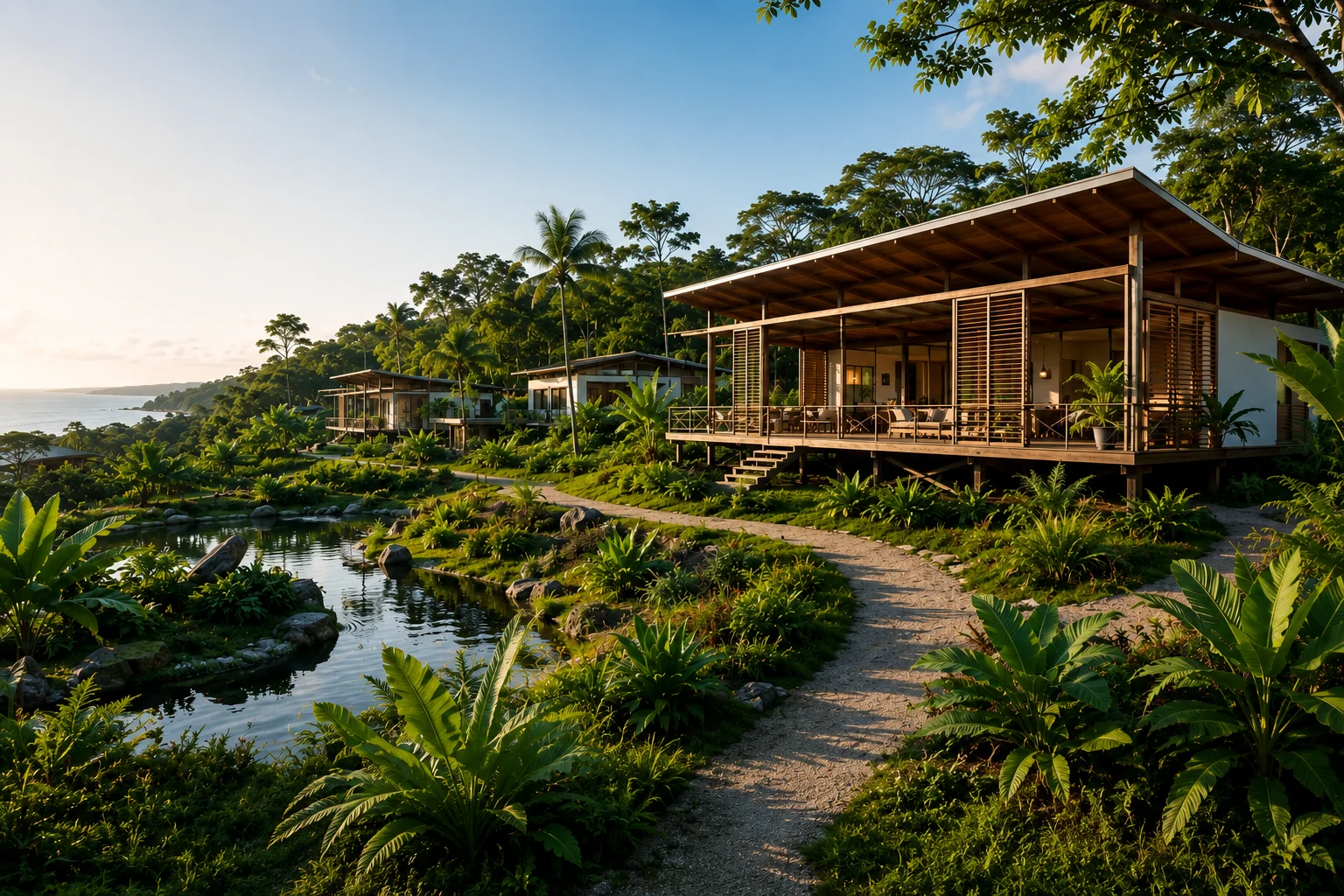
There is a question that everyone who buys land in Panama ends up asking — usually before speaking to an architect, often before deciding who to work with.
How much does it cost to build a house here?
The question seems simple. The answer is not. Most sources available online give figures that don't reflect current market reality, don't distinguish between project types, and rarely mention the variables that impact the final budget the most.
This article is an attempt to change that.
01 Why this question is so hard to answer
Construction costs in Panama vary significantly across four factors: the location of the land, the chosen construction system, the quality of finishes, and professional fees. When someone asks "how much does it cost?", they are looking for a number that depends on at least a dozen decisions they haven't made yet.
In remote coastal areas of the Panamanian Caribbean — Costa Arriba de Colón, Bocas del Toro — material transport can represent 12 to 20 percent of the total budget. A barge to carry cement blocks and rebar to a coast with no road access can cost more than the materials themselves. That doesn't show up in any online calculator.
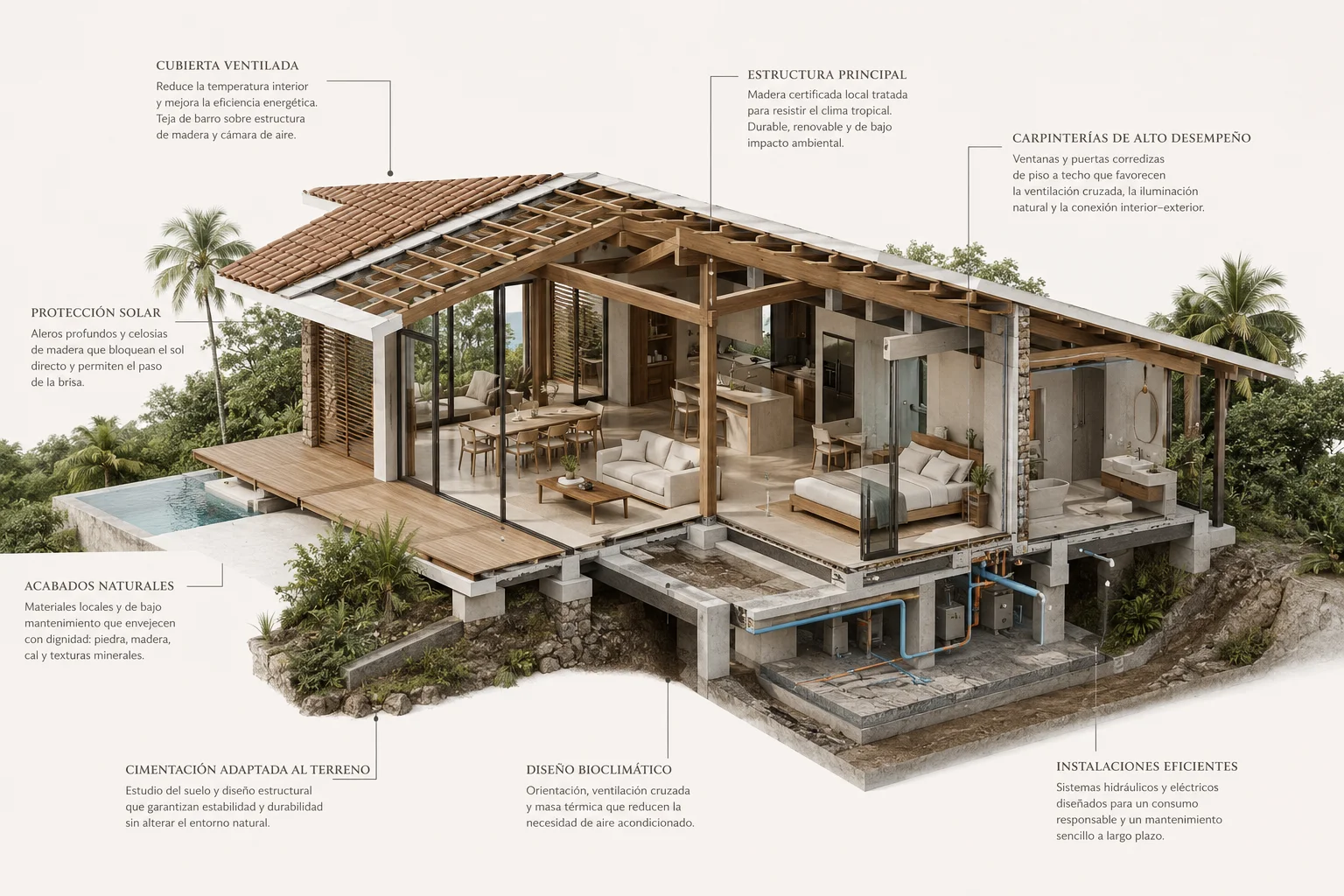
Another factor rarely mentioned: the structure — foundation, columns, beams, slab — represents only 40 to 45% of the total cost. The rest is made up of electrical and plumbing systems, finishes, carpentry, kitchen, bathrooms and professional fees. When someone calculates "how much does it cost to build", they are usually thinking only about the structure. And that is exactly half the problem.
02 Cost ranges by project type — Panama 2026
The following ranges are based on projects executed and consulted in Panama over the past three years. They include materials, labour and site management, but do not include architecture and engineering fees, which are detailed below.
| Project type | Range per m² |
|---|---|
| Basic construction | 700 – 900 USD/m² |
| Mid-range housing | 900 – 1,200 USD/m² |
| Premium design housing | 1,200 – 1,800 USD/m² |
| Beach house / coastal zone | 1,300 – 2,000 USD/m² |
| Tourism project (glamping, cabins, eco-lodge) | 1,100 – 1,700 USD/m² |
| Estimated total — 150 m² build | 200,000 – 320,000 USD |
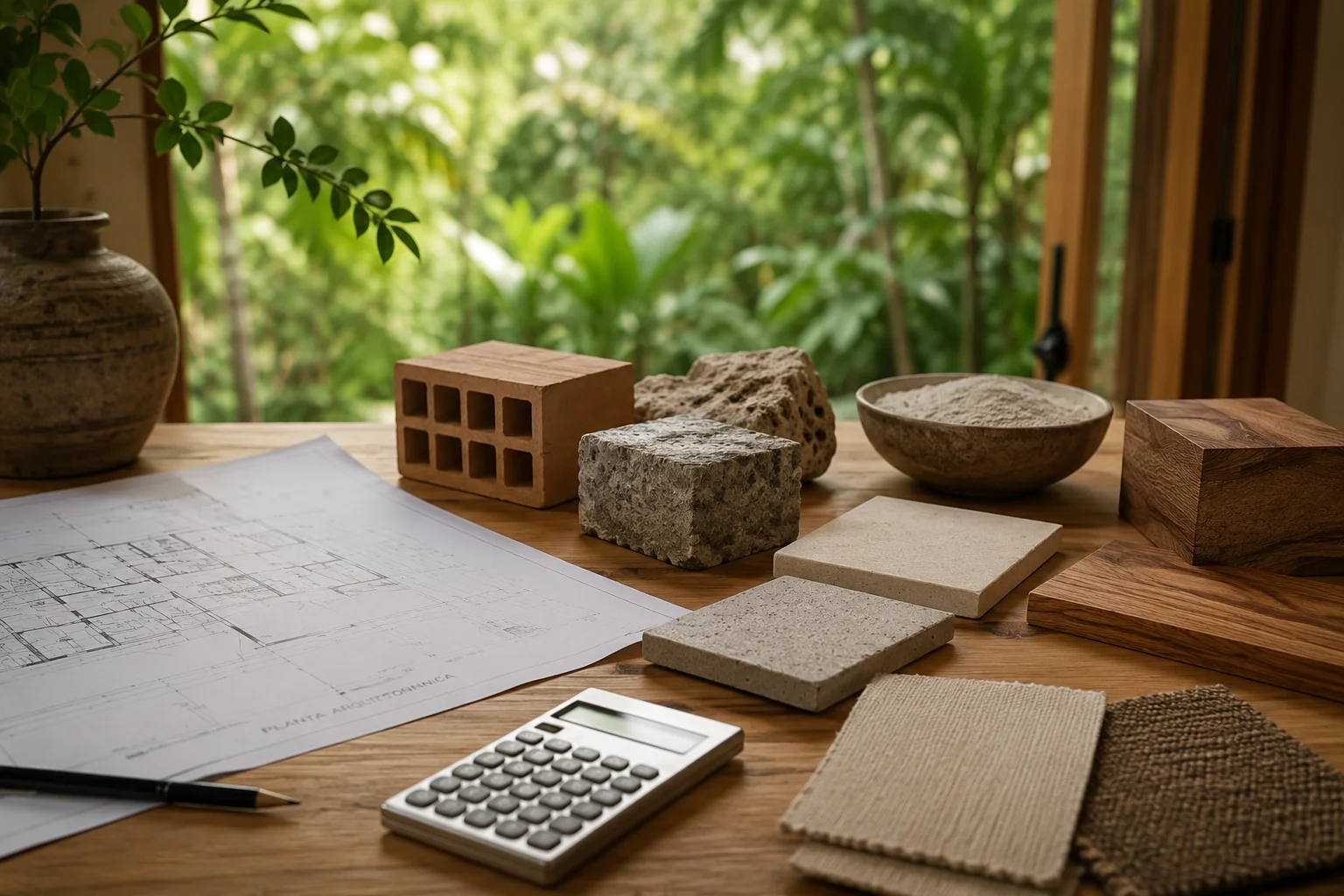
Why such a wide range within each category? Because "beach house" covers both a simple block cabin in Las Lajas and a board-formed concrete villa with an infinity pool in Bocas del Toro. The price per square metre never tells the whole story on its own.
03 The variables that impact the final budget most
Beyond project type, five factors generate the greatest cost differences in our experience — for better or worse.
-
01
The land and its accessibility. Land without vehicle access, on a steep slope or with title issues multiplies costs before construction even begins. The topography determines the foundation type; logistics determine material prices.
-
02
The quality of the architectural project. A well-developed project — with precise construction details, clear specifications and complete drawings — reduces errors on site and ambiguous negotiations with contractors. An incomplete project generates changes, rework and unforeseen costs.
-
03
Supplier and materials management. In remote areas, purchasing critical materials in advance and storing them can generate significant savings. Improvised purchasing is always expensive.
-
04
Professional supervision. A build without continuous technical supervision tends to end up costing more than a well-supervised one. Construction errors detected late are expensive to correct; those detected early are not.
-
05
Climate and appropriate materials. In the Panamanian tropics, choosing materials that cannot withstand humidity, salinity or rain cycles is one of the most expensive long-term mistakes. The real cost of a project includes the first ten years of maintenance.
04 How to structure your project budget
One of the most useful tools at the start of a project is a breakdown by component. Rather than thinking in terms of a global figure, it is more useful to understand what portion of the budget goes to each line item.
| Component | % of total cost |
|---|---|
| Structure and shell | 40 – 45% |
| Electrical and plumbing systems | 10 – 15% |
| Interior finishes | 15 – 20% |
| Carpentry and hardware | 8 – 12% |
| Kitchen, bathrooms and fixtures | 8 – 10% |
| Professional fees | 10 – 12% |
| Contingency (always reserve this) | 10% |
If someone gives you a budget that doesn't include a 10% contingency, add it yourself. It's not pessimism — it's basic financial management in any construction project. In Panama, with its particular climatic and logistical conditions, that reserve is not optional.
"The cheapest stage of a construction project is always the preliminary diagnosis. The most expensive, always, is fixing what was done wrong."
05 The phased process: how to reduce financial risk
One of the advantages of working in phases is that it allows investment decisions to be made progressively. Rather than committing to a full budget from the outset — when there are still many unknowns — each phase delivers information that makes the next decision smarter.
-
01
Feasibility assessment — 2 to 3 weeks
Analysing the land, applicable regulations, access constraints and construction possibilities. This step defines what can be built and roughly what it will cost. It is the smallest investment in the process — and the one that can save the most money afterwards.
-
02
Preliminary design — 4 to 8 weeks
Volumetric design, spatial layout, facades and itemised budget. With this phase complete, you have enough information to compare contractor proposals with real criteria, not assumptions.
-
03
Construction documents — 2 to 4 months
Complete construction drawings, technical details, material specifications and structural calculations. This is the document that goes to tender with contractors and allows for accurate budgeting.
-
04
Site supervision
Periodic technical supervision, progress reviews, quality control and change management. This phase is what ensures the built project is faithful to the designed project.
06 Three common mistakes that drive up project costs
-
01 — Hiring the contractor before the architect
When the contractor arrives before the architect, the project is built on intuition, not design. Changes on site are always more expensive than changes on paper. A good architectural project allows contractor budgets to be compared on the same specifications — and that is real transparency. Without complete drawings, every contractor prices something different and comparison is impossible.
-
02 — Not reserving the 10% contingency
Every construction project has unexpected events: a water table higher than expected, a material that arrives with a different specification, a regulation that changes during permitting. The contingency is not a margin for error — it is the difference between a project that finishes smoothly and one that stalls halfway through.
-
03 — Underestimating installation and finishing costs
The most frequent mistake: the initial budget reflects the structure well but underestimates installations, finishes and carpentry. In a tropical beach house, treated wood carpentry, natural ventilation systems and marine humidity protection can represent more than 30% of the total cost.
07 Before talking numbers, let's talk about the land
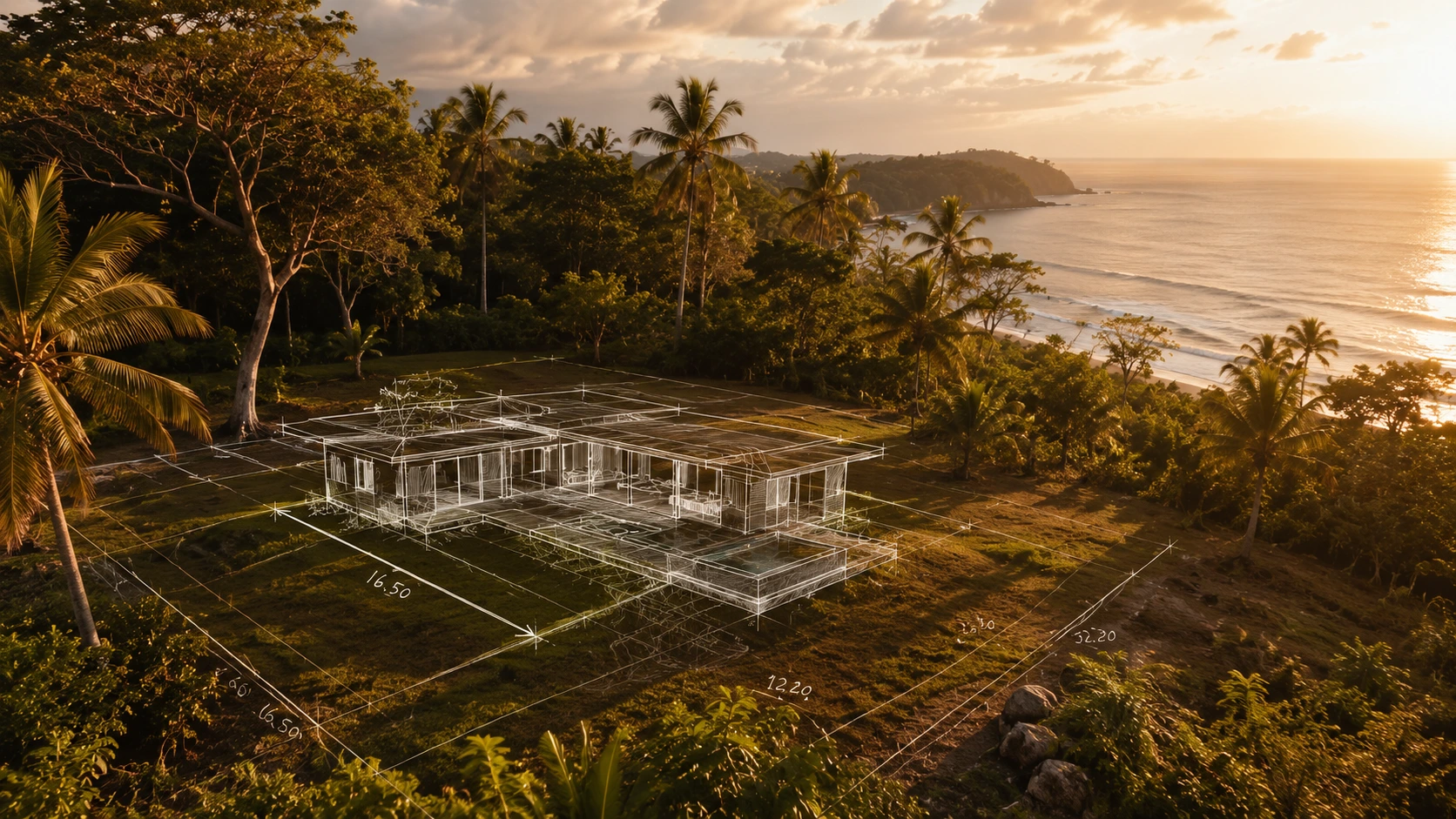
Everything above assumes something fundamental: that you already know what you want to build and on which piece of land. In practice, the real question is often not "how much does it cost?" but "what is it actually possible to build on this land?"
The land defines the project. Its topography, orientation, access, soil type, applicable regulations and relationship with the natural environment are the variables that determine what can be done — and at what budget it makes sense to do it.
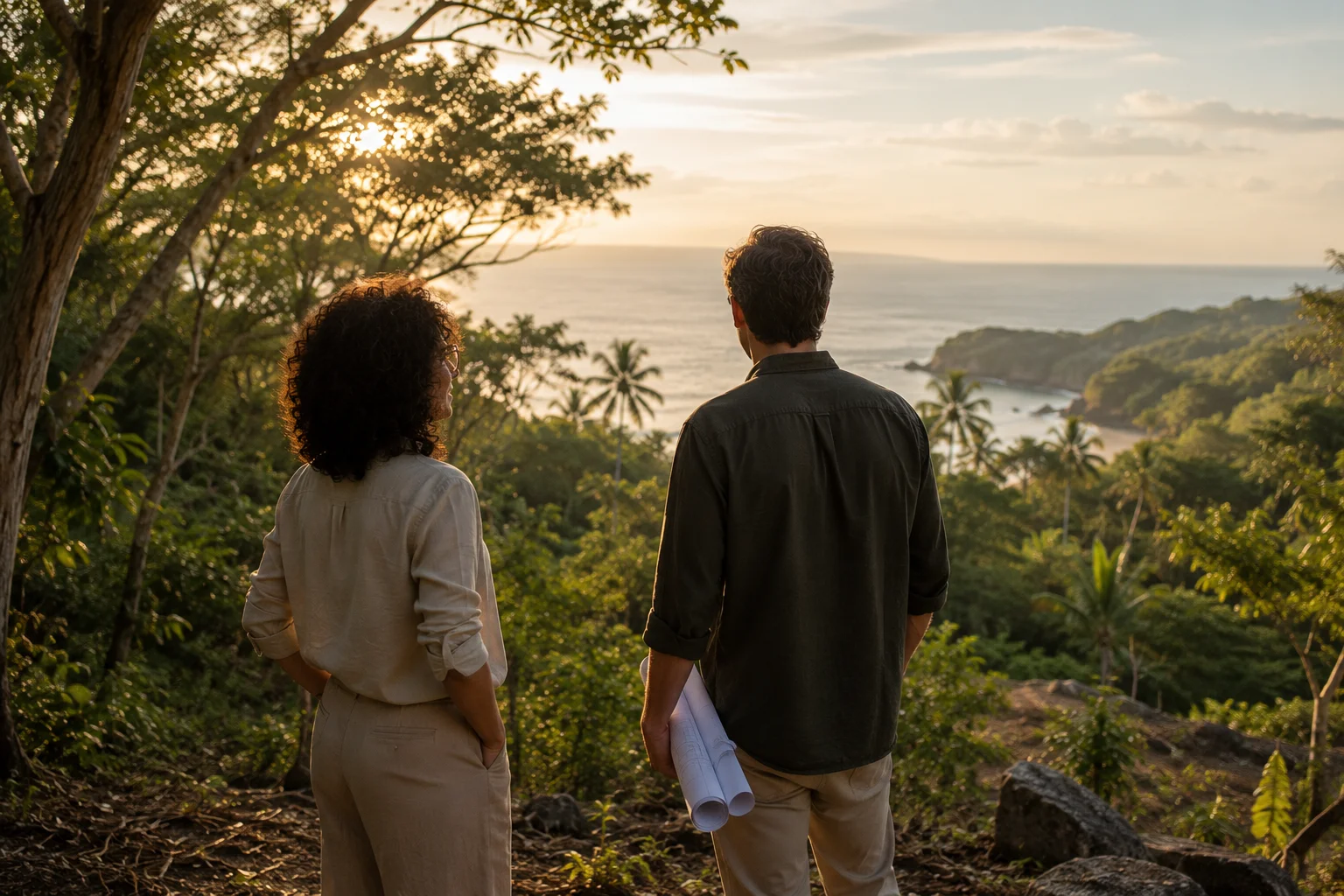
That is why, at Biotopos, the first conversation is not about square metres or budgets. It is about the land. What we have. What is possible. What makes sense.
That conversation has no cost. And it tends to prevent many.
If you already have clarity on your land and want to understand what kind of project to develop on it, the article Can I build on my beachfront land in Panama? walks through the four legal and environmental variables that determine what is possible on coastal land before a single line is drawn.